
Polonnaruwa Archaeological Site

The Polonnaruwa Kingdom, also referred to as the Ancient City of Polonnaruwa, served as Sri Lanka’s second capital for a period of three centuries, spanning from the 11th to the 13th century. This historical city gained prominence following the destruction of the Anuradhapura Kingdom in 993. Located in the north central province of Sri Lanka, the Polonnaruwa Kingdom was renowned for its advanced agricultural practices. Recognizing its archaeological significance and ancient technological advancements, UNESCO designated Polonnaruwa as a World Heritage site in 1982 under the name of the Ancient City of Polonnaruwa.
Polonnaruwa, which was the medieval capital of Sri Lanka from the eleventh to the end of the first quarter of the 13th century AC, also has evidence of human settlements dating back as far as the second century BC. This is evident from the presence of the “Madalaya’s Cave,” a cave with an inscription on its drip-ledge that indicates its age. It is believed that a chieftain (mandalika) may have donated the cave for the use of forest monks.
The Past of Polonnaruwa Kingdom
King Vijayabahu 1 declared Polonnaruwa as the capital city, after successfully defeating the Chola invaders in 1070. This victory allowed him to reunite the nation under local leadership. During the reign of King Parakramabahu, from 1153 to 1186, the country witnessed remarkable advancements in rice cultivation. The construction of an extensive irrigation network, including reservoirs that resemble natural inland seas, contributed to Sri Lanka’s reputation as the Granary of the Orient. Polonnaruwa now stands as a testament to the grandeur and opulence of King Parakramabahu’s kingdom. The ancient city, with its ruins, remains one of the most well-planned archaeological sites in the country, showcasing the discipline and greatness of its early rulers.


The Great King Parakramabahu
During the reign of King Parakramabahu, Polonnaruwa experienced a period known as the Golden Age. Under the king’s patronage, trade and agriculture thrived. King Parakramabahu was particularly determined to make the most of every drop of water that fell from the heavens, ensuring that it was utilized for the development of the land. As a result, irrigation systems were constructed during his reign that surpassed those of the Anuradhapura era. These systems, including the renowned Parakrama Samudra or the Sea of Parakrama, continue to provide the much-needed water for paddy cultivation in the arid eastern region of the country, even to this day.
Ruins of the Royal Palace of greater King Parakramabahu
Originally, the Vijayantha Prasada Palace in Polonnaruwa, Sri Lanka, was a seven-storied building with around 1000 chambers. It was constructed by King Parakramabahu the Great (1153-1186) and is situated within the inner city of the Polonnaruwa UNESCO World Heritage archaeological site. Due to its seven stories, the palace was also known as “Sath Bumupaya” in Sinhala. The remaining massive walls, with a thickness of over one meter, along with parts of the stairs and foundation walls, provide a glimpse into the grandeur of the building. These walls, over a meter thick and reaching a height of about 30 feet, as well as the lower half of the main stairway leading to the upper floors, can still be observed today. Additionally, remnants of melted brick walls, resulting from the intense heat when the palace was set on fire by Chola invaders at the end of the Polonnaruwa era, can be seen. This site holds significant importance for archaeological educational tours in Sri Lanka.
Kumara Pokuna (Royal Bath)
The Kumara Pokuna, or Royal Baths, located in Polonnaruwa, stands as an extraordinary archaeological site that highlights the magnificence and sophistication of ancient Sri Lankan culture. These baths exemplify architectural brilliance, featuring graceful designs and detailed stone carvings. The expansive rectangular pools, flanked by steps and platforms, indicate a space dedicated to leisure and purification for the royal elite. The construction of Kumara Pokuna showcases the advanced engineering capabilities of its era. The employment of substantial stone blocks and meticulous masonry reflects the exceptional craftsmanship of the ancient artisans. Nestled amidst lush greenery within the historical precincts of Polonnaruwa, the Kumara Pokuna provides a window into a past filled with luxury and grandeur. It is an essential destination for history buffs and anyone interested in appreciating the beauty and ingenuity of ancient architectural achievements.
Polonnaruwa Vatadage (Circular Relic Chamber)
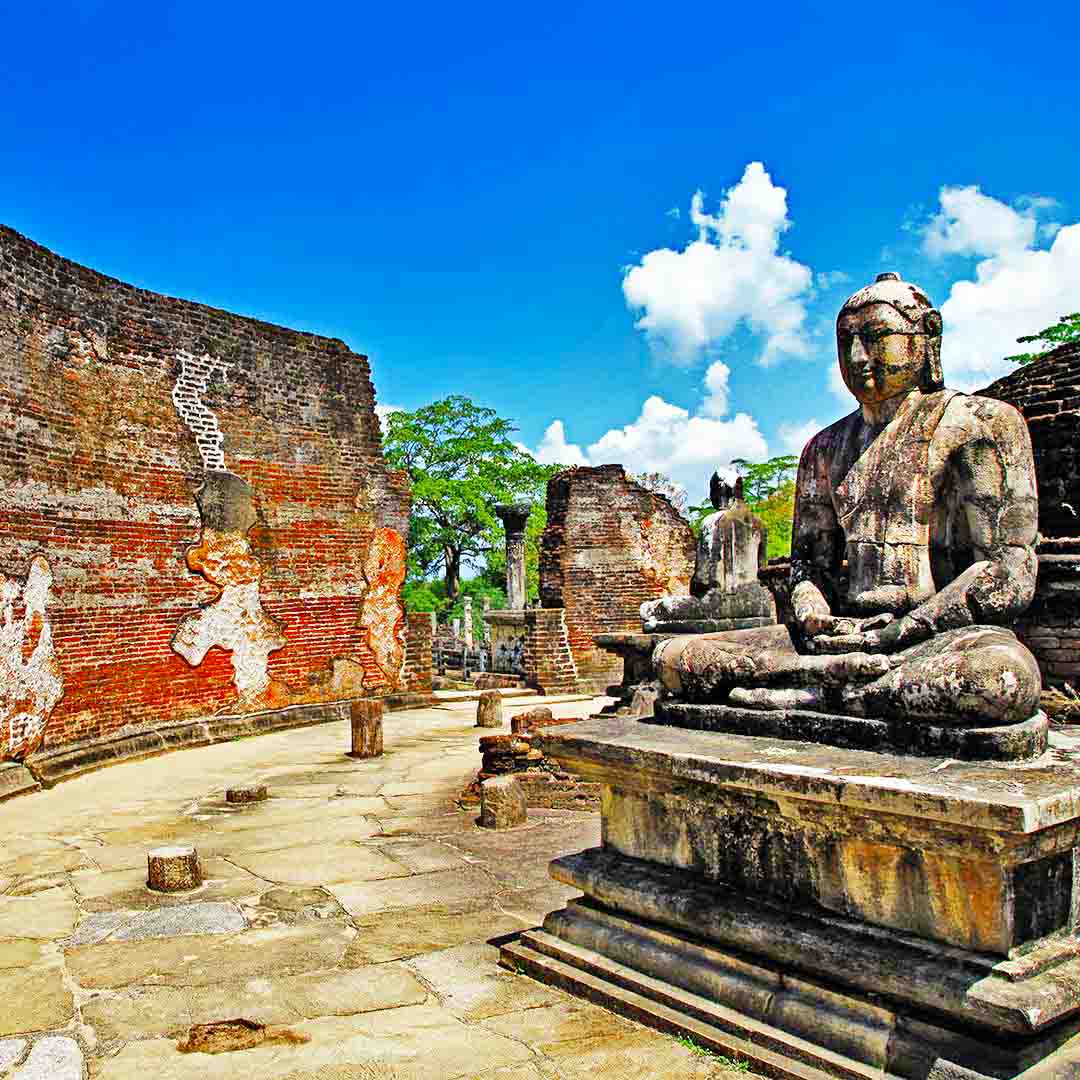
Constructed either during the reign of King Parakramabahu to accommodate the Buddha’s tooth relic or during the reign of Nissanka Malla of Polonnaruwa to house the Buddha’s alms bowl, this edifice holds immense historical significance due to these revered artifacts. It exemplifies the architectural style of a traditional Sri Lankan Vatadage, featuring the distinctive bubble-shaped design known as Buddulakara. This site is highly recommended for educational tours focused on archaeology in Sri Lanka.
Gal Vihara
Gal Vihara, also known as Uththara Ramaya, is a Buddhist rock shrine located in the UNESCO World Heritage city of Polonnaruwa in Sri Lanka. If you are planning a visit to Polonnaruwa, this is definitely a place you should not miss. The shrine is home to four magnificent rock statues, each representing a different Buddha image. The first statue depicts Buddha seated on a lotus, while the second one is a smaller seated figure. The third statue portrays Buddha in a standing position, and the last statue showcases Buddha in a reclining pose. Gal Vihara holds great significance as it is considered the most prominent among the hundred temples constructed by King Parakramabahu across Sri Lanka. It is a significant destination for Buddhist pilgrimage tours in Sri Lanka.
Sandakada Pahana (Moonstone)
Moonstone is an extraordinary feature of ancient architectural design. Sandakada Pahana, a beautifully crafted semi-circular stone slab, is typically positioned at the base of staircases and entrances. It serves as a representation of religious beliefs in a variety of ways. Scholars in the field of archaeology suggest that the Sandakada Pahana symbolizes the cycle of Saṃsāra in Buddhism. I highly recommend observing this historical symbol while on your vacation in Sri Lanka, as it provides a glimpse into the rich Buddhist culture that has thrived for centuries in this country.
Parakramabahu Statue / Sage Pulasthi Statue
The Parakramabahu statue, situated in the Polonnaruwa Ancient City, stands as a magnificent monument facing the Parakrama Samudra Reservoir. Crafted by King Parakramabahu I, this colossal statue finds its place near the Potgul Vihara monastic complex. Carved into a large rock during the 12th Century AD, it is considered one of the most exquisite stone statues from that era. Standing at a height of approximately twelve feet, the statue portrays a man with a solemn yet wise expression. His half-closed eyes and melancholic smile accompany his act of reading, believed to be from a manuscript held at chest height.
